Superficial Femoral to Below-the-Knee Popliteal Artery Bypass for Popliteal Artery Aneurysm Containing Mural Thrombus
Brett J. Salomon, MD1,2; Tiffany R. Bellomo, MD1,2; Zachary M. Feldman, MD, MS1,2
1Massachusetts General Hospital
2Heart and Vascular Institute, Mass General Brigham
Popliteal artery aneurysms (PAAs) are the most common peripheral arterial aneurysms, with an incidence of approximately 10.4 cases per million per year and occur most frequently in men aged 60–70 years. Many lower extremity aneurysms are asymptomatic and are discovered incidentally on physical examination or imaging performed for unrelated conditions. However, symptoms resulting from compression of surrounding structures can occur and may be disabling, including deep vein thrombosis and neuropathies. The most serious complication is acute limb ischemia resulting from thrombosis or distal embolization. For this reason, the Society for Vascular Surgery (SVS) clinical practice guidelines recommend operative repair when an asymptomatic aneurysm reaches 20 mm in diameter or contains mural thrombus.
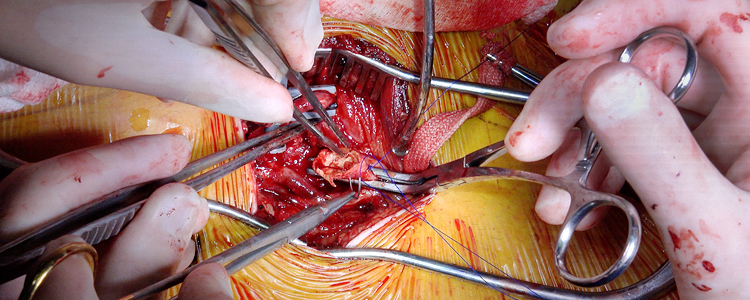
This article presents the case of a 67-year-old male with a 22-mm right PAA with significant mural thrombus. Given his right PAA was greater than 2 cm and had significant mural thrombus, he was evaluated for intervention. An intraoperative angiogram identified proximal and distal sites for bypass that were free of mural thrombus. Therefore, the patient underwent a superficial femoral to below-the-knee popliteal artery bypass using a great saphenous vein conduit through a medial incision in the supine position. The superficial femoral artery and below-the-knee popliteal artery were dissected free from the surrounding structures. The case required local thromboendarterectomy of the below-the-knee popliteal artery and tibioperoneal (TP) trunk, due to the presence of chronic thrombus at the endpoint that was not able to be visualized on preoperative angiography. A bypass was created between the two arteries, and the native artery was ligated, including the aneurysm.
The case highlights operative management of a PAA as well as the techniques involved in lower extremity bypass. Lower extremity bypass remains an important procedure for vascular and trauma surgeons who may need to perform this procedure for multiple pathologies.